

On this page
- 01What Are the Three Toilet Formats Sold in the UK?
- 02What Exactly Is a Close Coupled Toilet?
- 03What Is a Back to Wall Toilet?
- 04What Is a Wall Hung Toilet?
- 05How Do the Three Compare Where It Matters?
- 06Back to Wall vs Wall Hung vs Close Coupled: Which Should You Choose?
- 07Where Does Rimless Fit In?
- 08Which Formats Do We Actually Manufacture?
- 09Why Is Back to Wall Our Largest Family?
- 10What Should a Buyer Verify Before Ordering?
- 11Which Claims About Toilet Formats Should You Discount?
- 12FAQs About Close Coupled, Back to Wall and Wall Hung Toilets
What separates close coupled, back to wall and wall hung toilets, where rimless fits in, and the checks that matter before ordering for European and UK projects.
Key Takeaways for Procurement & Engineering Teams
- The three formats sold across the UK — close coupled, back to wall and wall hung — differ in two things only: where the cistern sits and what supports the pan. Everything else follows from those two decisions.
- Close coupled is the default: pan and cistern bolted into one unit, everything exposed and serviceable. Back to wall keeps the pan on the floor but hides the cistern in furniture or the wall. Wall hung cantilevers the pan off a steel frame.
- Rimless is not a fourth format. It is a bowl architecture that overlays any of the three, removing the under-rim cavity so the flush sweeps the whole bowl surface.
- Our range runs twenty-one models: nineteen back to wall pans — the European and UK workhorse, fifteen of them two-piece bodies with their own close coupled cisterns — plus one wall hung rimless pan and one one-piece body. Eighteen of the twenty-one are rimless.
- The most expensive mistakes in this category are planning mistakes: no access panel for a concealed cistern, a rough-in assumed instead of measured, a carrier frame as an afterthought.
- Concealed-cistern formats move the servicing question from the cistern itself to the installation plan. Insist on the access route at specification stage, not after tiling.
What Are the Three Toilet Formats Sold in the UK?
Walk into any British bathroom retailer and the toilets on display sort themselves into three groups, by the same two questions the trade uses: where does the cistern sit, and what carries the pan.
In a close coupled toilet, the cistern sits directly on the back of the pan and the two are bolted into one unit; the pan stands on the floor. In a back to wall toilet, the pan also stands on the floor and is fixed against the wall, but the cistern is concealed — inside a furniture unit or inside the wall behind a flush plate. In a wall hung toilet, the pan is suspended clear of the floor on a steel carrier frame that also houses the cistern.
That is the entire taxonomy. Everything buyers read about style, cleaning, installation and servicing is a consequence of those two structural decisions, which is why the same three names appear in every UK buying guide with only the adjectives changed.
The distinction matters differently on each side of the transaction: for a household it is a design and maintenance decision, while for a distributor or project buyer it is a stocking decision — the three formats fail in different ways, and the installation skills they require do not overlap completely.
What Exactly Is a Close Coupled Toilet?
Close coupled is the default British bathroom toilet, and the definition is mechanical: the cistern bolts directly onto the back of the pan through a coupling kit, forming a single unit that connects to the floor and, in most installations, to a wall-outlet soil pipe behind it.
Its advantages are the reasons it dominates. Installation is the simplest of the three — everything is exposed, the cistern lid lifts off for access, and most plumbers fit one quickly. Replacement is equally direct: the critical measurement is the rough-in, the distance from the wall to the centre of the waste outlet, and a buyer who measures it before ordering can swap like for like.
The format also carries variants that matter in practice. An open back close coupled pan leaves a gap behind for the pipework to run visibly but accessibly — the forgiving option where existing plumbing does not sit neatly. A closed back variant sits flush to the wall and hides the pipework, at the cost of needing the pipe positions right the first time.
What Is a Back to Wall Toilet?
A back to wall toilet keeps the pan on the floor but removes everything else from view: the pan fixes firmly against the wall, the cistern is concealed inside a furniture unit or the wall cavity, and the only visible control is a flush plate or button. Because the weight goes through the floor, no carrier frame is needed — the streamlined look of a wall hung toilet with a fraction of the structural work.
The trade-off moves from structure to planning: the cistern is out of sight, so access for future servicing depends entirely on how the installation was planned — which is why the access panel is the single detail worth insisting on. The full format breakdown — build options, UK flush-volume regulation, wall and drainage readiness, and the RFQ lines that matter — is in our back to wall toilet buyer's guide.
Trade listings sometimes describe a close coupled pan with a flat rear skirt as a back-to-wall close coupled toilet. It is not the same product: that variant still has its cistern bolted on top, merely hidden from the side. A true back to wall toilet has no cistern on the pan at all. Read the specification, not the adjective.
What Is a Wall Hung Toilet?
A wall hung toilet is the signature look of the contemporary European bathroom: the pan floats a short distance above the floor, fixed to a steel carrier frame concealed behind the wall or the furniture, with the cistern inside the frame and a flush plate as the only visible part.
The frame is the load path. It carries the pan, the cistern and the user, and it must be fixed back to structure — which is why installation belongs to the demanding end of the category: the frame, the tiling and the plate all have to be planned together, typically in new builds or full remodels rather than like-for-like swaps.
What it buys is unmatched in the other formats: the floor beneath the pan stays completely exposed, cleaning takes seconds, the room reads larger, and the hanging height is chosen at installation — the natural answer where a specific seat height is wanted.
For buyers comparing the three, wall hung is best understood as the premium expression of the idea a back to wall pan delivers more economically: a bowl with nothing around it. The difference is where the weight lands — floor versus frame — and everything in the specification follows from that one fact.
How Do the Three Compare Where It Matters?
The comparison a buyer actually runs is not aesthetic; it is operational. The table below compresses the three formats into the columns that decide a specification, with the price column deliberately left out — landed cost varies far more with cistern and seat quality than with format.
| Aspect | Close coupled | Back to wall | Wall hung |
|---|---|---|---|
| Cistern position | On the pan, exposed | Concealed in furniture or wall | Inside the carrier frame |
| Pan support | Floor | Floor, fixed to wall | Steel carrier frame in the wall |
| Floor contact | Full | Full | None — floor stays exposed |
| Installation complexity | Lowest of the three | Moderate — cistern housing needed | Highest — frame, structure, tiling |
| Servicing access | Lift the cistern lid | Through the access panel or furniture | Through the flush plate opening |
| Cleaning around the pan | Standard | Easier — flush to wall | Easiest — floor fully exposed |
| Typical role in a range | The reliable default | The modern workhorse | The design-led statement |
Back to Wall vs Wall Hung vs Close Coupled: Which Should You Choose?
The table settles what each format is; the decision itself is a short list of conditions. Read the project against the three cases below and the choice usually makes itself.
Choose a close coupled toilet when the job is a like-for-like replacement, the programme is tight, or the property is rental or social housing where exposed, serviceable parts beat concealed ones. It is also the forgiving choice where existing pipework does not sit neatly — the open-back variant absorbs imperfect pipe positions.
Choose a back to wall toilet when you want the concealed, fitted look without the structural project: the pan stays on the floor, no carrier frame is needed, and the cistern hides in furniture or the duct behind. It is the format that scales across the widest spread of projects — apartments, hospitality washrooms, and any remodel where the wall cannot be opened. The single condition is the access panel, agreed before tiling.
Choose a wall hung toilet when the floor-free look is the point and the wall can carry a frame fixed back to structure: new builds and full remodels, installations where a specific seat height matters, and premium projects where cleaning speed is a selling feature. Between back to wall vs wall hung, the deciding question is never the look — the two look almost the same — it is where the weight lands and who does the work.
Where Does Rimless Fit In?
Rimless is the word doing the heaviest lifting in European toilet marketing, and it is routinely misunderstood as a format of its own. It is not a fourth option beside the three — it is a bowl architecture that overlays any of them: a rimless bowl removes the undercut rim cavity where residue accumulates, so every wettable surface stays visible and reachable. Our rimless pans pair the rimless bowl with a fully glazed trapway and a 4/6-litre dual flush as standard, in close coupled, back to wall and wall hung bodies alike.
The full hygiene case — what rimless changes, what it does not, and where the marketing word outruns the engineering — is covered in our rimless toilets pros and cons guide. The round-front and D-shape bodies below carry exactly that pairing in two of the bowl shapes the European vocabulary covers.
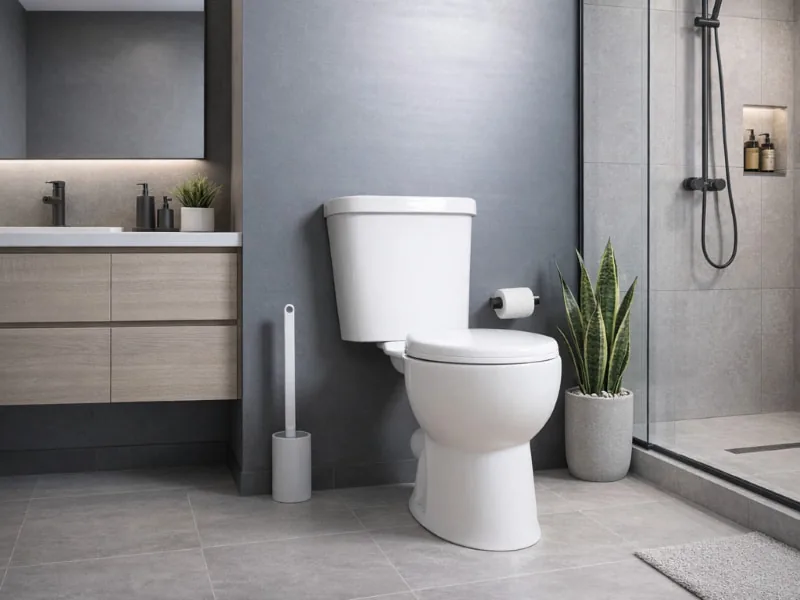
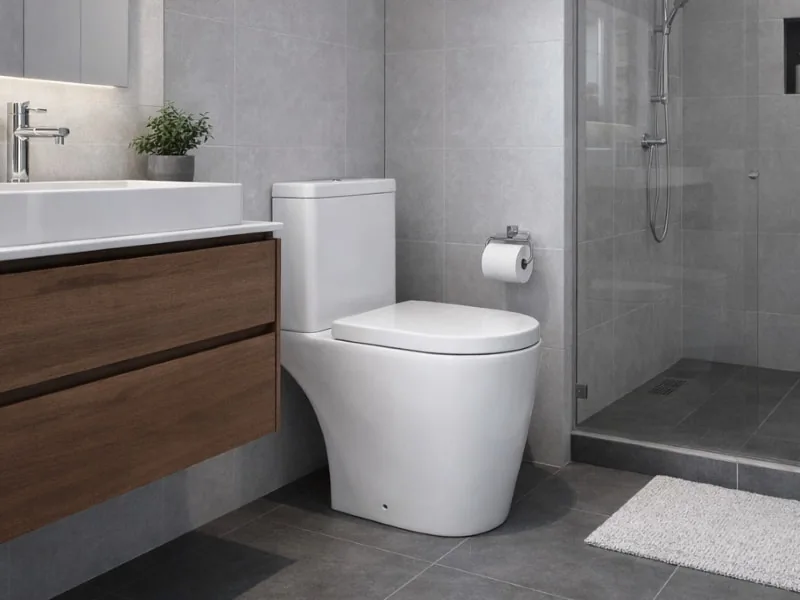
Rimless two-piece bodies from the current range:
Which Formats Do We Actually Manufacture?
Our toilet range runs twenty-one models, and its shape reflects where the European and UK market is actually buying: nineteen of the twenty-one are back to wall pans — fifteen of them CT-series two-piece bodies whose ceramic cisterns bolt directly to the pan, close coupled in construction — complemented by one wall hung rimless pan and one one-piece body. Eighteen of the twenty-one are rimless.
| Model | Format | Dimensions (mm) | Rimless |
|---|---|---|---|
| CB10603 | Back to wall (pan, concealed cistern) | 520 × 360 × 425 | Yes |
| CB10758 | Back to wall (pan, concealed cistern) | 520 × 360 × 420 | Yes |
| CB10228 | Back to wall (pan, concealed cistern) | 525 × 355 × 420 | Yes |
| CT11815C | Back to wall (two-piece, integrated ceramic cistern housing) | 620 × 375 × 835 | Yes |
| CH10603 | Wall hung | 520 × 360 × 365 | Yes |
| CA10910 | One-piece (integrated tank) | 660 × 360 × 770 | No |
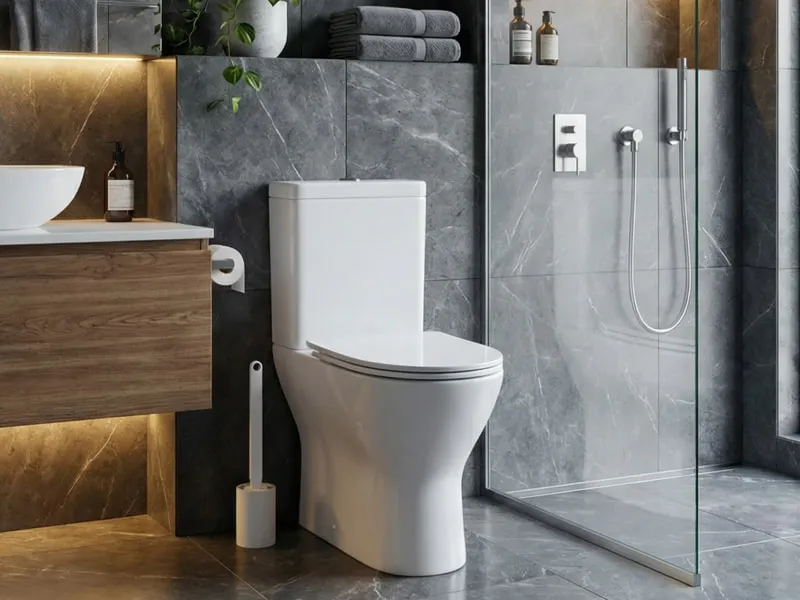
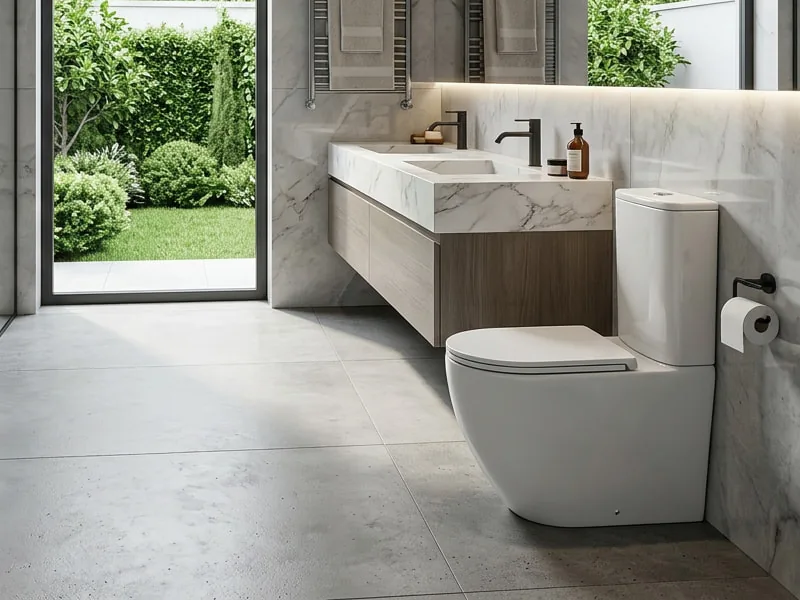
Two of the fifteen two-piece bodies in current production:
Why Is Back to Wall Our Largest Family?
The nineteen-pan back to wall family is a deliberate position, not an accident of the catalogue. Back to wall is where the European mainstream has landed: it delivers the concealed, fitted look that wall hung is famous for, without the structural project a carrier frame imposes — which makes it the format that scales across the widest spread of projects, from city apartments to hospitality washrooms.
Within the family, the variation buyers choose between is geometric. The compact pans run a projection of about 520 mm — the depth that decides whether the door of a small bathroom clears the bowl. Larger two-piece skirted bodies run deeper because they carry the cistern's mass in the body itself. Bowl shapes across the range follow the European vocabulary of round-front, D-shape and soft-square forms.
Every pan in the range shares one service architecture: a P-trap wall outlet at the European-standard 180 mm rough-in, a washdown dual flush at 4/6 litres, and a vitreous china body fired at 1280°C with water absorption below 0.2 per cent. Seats are UF soft-close units with quick-release hinges, so the bowl opens for cleaning without tools.
For a distributor, the practical reading of the range is coverage: one format, one trap standard, one flush philosophy, in enough projections and bowl shapes to fill a planogram without introducing a second set of installation instructions.
What Should a Buyer Verify Before Ordering?
The three formats fail in different places, and the checks that prevent the failures are cheap to run at specification stage.
Measure the rough-in. For replacement work in the UK, the outlet height — from the finished floor to the centre of the wall spigot — is the dimension that decides whether a like-for-like swap is actually like-for-like. European wall-outlet pans are built around a 180 mm P-trap outlet height, and a pan ordered against an assumed dimension is a pan that comes back.
Concealed-cistern formats move the servicing question into the installation plan, and the trade guidance converges on one instruction: insist on an access panel or a removable furniture front, agreed at specification stage. A concealed cistern behind a sealed wall is not a modern bathroom feature; it is a future demolition.
Match the frame to the wall, not the catalogue. Wall hung installations need the carrier frame fixed back to structure, and the frame specification is the frame manufacturer's to state — a buyer's job is to make sure the wall being offered can carry it.
And confirm the paper trail. For European and UK destinations that means EN 997 flush-performance certification, CE or UKCA marking as the destination requires, and ISO 9001 certified manufacturing behind them — with certificate file numbers available on request. The technical drawing for the exact model completes the set: projection, trap position and flush volume are all on it.
The concealed cistern is the format's best feature and its only real liability, and the difference is one decision made early: an access panel in the wall, or a furniture front that opens. Specify it when the pan is specified, and the format has no downside worth mentioning.
Which Claims About Toilet Formats Should You Discount?
Toilet marketing carries a few claims that deserve a sceptical reading — not because they are false, but because they are not the decision.
Rimless means a specific bacteria reduction. Percentage hygiene claims circulate widely in this category with no test method attached. The honest version of the rimless case is structural: the under-rim cavity is gone, so there is nowhere hidden for residue to sit. A number without a method is marketing.
Wall hung is fragile. A correctly installed pan hangs on a steel frame fixed to structure, and the format is a commercial-washroom staple precisely because it survives heavy use — fragility is a property of a bad installation, not of the format.
Back to wall is just a cheaper wall hung. The two share an aesthetic and almost nothing else: different load path, different cistern housing, different installation trade. Choosing between them is choosing where the weight lands and who does the work, not a discount decision.
One trap standard fits every market. The 180 mm P-trap wall outlet covers the European and UK mainstream, which is why most of our range sits on it — but outlets, flush volumes and fittings conventions differ by market. Confirm the destination before the container, not after it.
FAQs About Close Coupled, Back to Wall and Wall Hung Toilets
What is the difference between close coupled, back to wall and wall hung toilets? Two things: where the cistern sits and what supports the pan. Close coupled bolts the cistern on top of a floor-standing pan; back to wall hides the cistern in furniture or the wall behind a floor-standing pan; wall hung suspends the pan off a steel carrier frame that houses the cistern.
Which format is most common in the UK? Close coupled remains the default in British homes — it is the simplest to install and service. Back to wall and wall hung are the formats the modernising market is moving toward, with back to wall the more common of the two.
Does a back to wall toilet need a frame? No. The pan stands on the floor and the weight goes through it, so no carrier frame is required — only a concealed cistern in the furniture or the wall behind. That is the format's core advantage over wall hung.
Why do wall hung toilets need a carrier frame? The pan carries no load from the floor; the frame does. It is a steel structure fixed back to the building's structure that carries the pan, the cistern and the user, and it must be specified against the wall it is being fixed to.
Is rimless a separate type of toilet? No. Rimless describes the bowl architecture — no under-rim cavity, flush water distributed by the pan's internal geometry — and it is available across all three formats. Our own range applies it to back to wall and wall hung pans alike.
What are the benefits of a rimless bowl? The hidden cavity beneath a conventional rim is where residue accumulates and a brush cannot reach. Removing it leaves every wettable surface visible and swept by the flush, so cleaning is simpler.
What is a fully glazed trapway? The internal passage from bowl to soil pipe carries the same glaze as the bowl, giving it the same smooth, non-porous surface. On an unglazed passage, the porous ceramic body is exposed exactly where waste flows.
What rough-in do European wall-outlet toilets use? The mainstream standard is a 180 mm P-trap wall outlet — the rough-in sixteen of our twenty-one models sit on, with 185 mm on three CT models and different outlets again on the wall hung and one-piece pans. For replacement projects, measure the existing outlet position before ordering rather than assuming it.
Which certifications cover the range for European and UK projects? EN 997 flush-performance certification, CE and UKCA marking, and ISO 9001 certified manufacturing — with certificate file numbers available on request. The compliance paperwork travels with the order, not after it.
What flush volume do UK toilets use? The UK convention is a 4/6-litre dual flush — four litres reduced, six full. Our pans pair with dual-flush cisterns at exactly those volumes, which is also where the water-efficiency conversation starts and ends honestly.
How do I choose between back to wall and wall hung? Decide where the weight should land and who is doing the work. Back to wall keeps the pan on the floor and needs only a concealed cistern; wall hung needs a carrier frame fixed to structure but leaves the floor completely clear. The aesthetics are close; the installations are not.
What should I check before ordering a concealed-cistern toilet? That the installation plan includes access — an access panel or an opening furniture front — agreed before tiling. The format's only real liability is a cistern that cannot be reached, and it is entirely avoidable at specification stage.
Which formats does TAITAO manufacture? Twenty-one models: nineteen back to wall pans — the European and UK workhorse format, fifteen of them two-piece bodies with close coupled cisterns — one wall hung rimless pan, and one one-piece body. Eighteen of the twenty-one are rimless. The range's mainstream rough-in is the 180 mm P-trap wall outlet, with 185 mm on three CT models, 55 mm on the wall hung pan, and a 295 mm S-trap floor outlet on the one-piece — all on 4/6-litre dual flush.
Related Engineering Deep-Dives
Fireclay vs Cast Iron vs Quartz: How They Fail
Fireclay, enameled cast iron and quartz composite do not differ in how well they are made. They differ in what goes wrong, and how visible it is when it does. A sourcing guide for importers.
Rimless Toilets: Why Hotels Specify Them
Why hospitality procurement keeps specifying mechanical rimless toilets over electronic smart models, where the cleaning and servicing costs actually sit, and what to put in a tender for each.